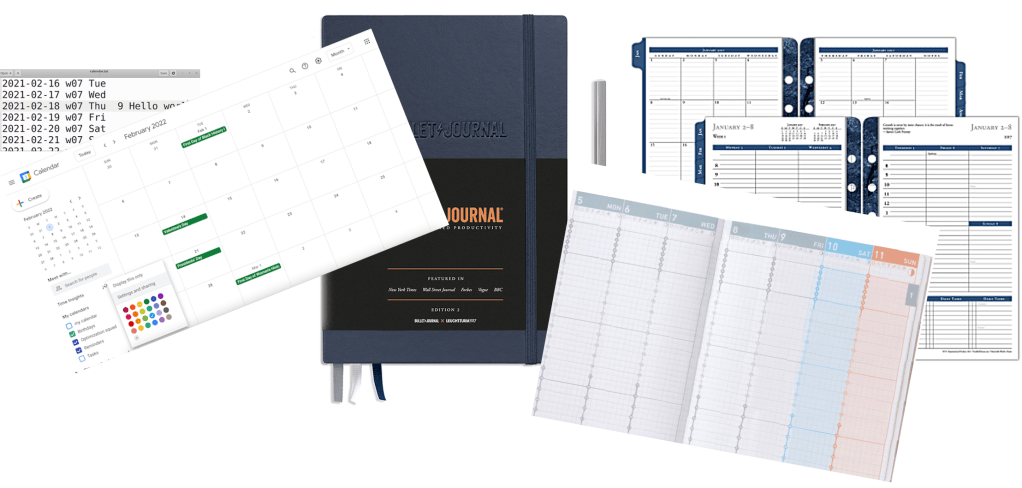
I read somewhere that we tend to think that the routine parts of our lives don’t deserve deliberate attention in a planner and a journal. I disagree; they do.
This post covers my thoughts and intentions, and the effort I put forth into my Personal Productivity System (PPS). While I am no one special, I work hard studying, building, iterating, shaping, and optimizing my PPS. I select and implement tools that demonstrate solid alignment to the intentions I’ve defined for this effort. Through iteration and the exploration and refinement of intentions, I continually tailor my PPS to the current version of me.
Intentions drive my efforts.
Intentions
I make time for the important people in my life.
I can demonstrate to myself a reasonable cadence of task completion and goal progression.
I’m on top of my obligations and I can be proactive and timely in making commitments.
When I handwrite my schedule and tasks, I build a strong connection, and I remember them better.
I enjoy memory-keeping. As time passes, many great things happen. One principal intention of this effort is to capture these.
I am a temporal being, traveling through time. As the future moves through the present and to the past, what matters changes.
Forward-looking: planning, scheduling, goal setting
Backward-looking: journaling, timeline tracking, memory-keeping
I use technology in ways that serve me best and that will do the job I need it to do. To do this, I must first clearly articulate the job or the need to be filled.
My data is mine. I store it online in a manner that provides backup and where I can view and edit my data on multiple devices. I share specific aspects of my planning system with others using digital tools.
I build a system that encourages me to write. I love to write, and I enjoy writing by hand. The time I spend writing builds a better connection between my memory and the material I’m writing about.
What is simple is sustainable and what is pleasurable is motivating. I build a system that is friction-free and that strives to eliminate barriers.
I defend the process, not the tool. I experiment and iterate with tools to improve the effectiveness of my process.
Philosophy
Planning is the process of creating an action plan for the present and the future based on awareness, values, reflection, goal setting and investment in personal development within the context of a career, education, relationship, and self-improvement. Planning isn’t about a planner; it’s about the system. Any planner I use is chosen so that it fits my planning system.
“It is a good idea, then, to keep in touch, and I suppose that keeping in touch is what notebooks are all about. And we are all on our own when it comes to keeping those lines open to ourselves: your notebook will never help me, nor mine you.” [Joan Dideon]
“Experiment until it clicks. Iterate until it sticks” [Rachelle In Theory]
Planning and Activity Intervals
Supported by a future log, I plan deliberately on daily and weekly intervals. I memory-keep monthly. I rebuild a Bullet Journal Mental Inventory quarterly. I build an annual plan to outline expected highlights and areas of focus for the year ahead.
Major Elements
Planning and Time Management (forward-looking): the act of outlining what will happen
Today
This Week
Future Log
Manage external calendars (e.g. volunteer or group scheduling)
Active Collections
Mental Inventory, as defined by the Bullet Journal Method
Radar. An item on the radar list will eventually become a project or a set of actions.
Quick Capture. One paper and one digital place to serve as an inbox.
Trigger List. A collection dedicated to prompts and topics I need to consider from time to time.
Values. These are durable, and not time bound
Vision Board. I build this annually to illustrate important goals and topics for the next year.
Goal Setting
Projects
Journaling
Notetaking and Personal Knowledge Management
A process to gather, classify, store, search, retrieve and share knowledge.
Subscription and Purchase Tracking
To Do – near term, recurring, long term
Memory keeping
Fun, Accessible Personal
My Planning Process
I have written down how I plan. I don’t always follow it because life sometimes gets busy. I built this plan so that I have a place to go back to that reminds me what I should do when I want my interval-based planning effort to be complete.
Step 1: Weekly Turnover
- Brain Dump
- Review the previous week, including daily schedules and notes
- Identify quick-captured notes
- Reflect on the week with reflection questions and prompts
- Trigger List and Radar. Review and update either, if needed.
- Complete any quick tasks that were deferred
- Populate my Bullet Journal monthly spread with daily entries
- Scan the current yearly spread
- Scan my most recent Mental Inventory
- Access my Future Log
- Review for completeness and for any changes, errors, or omissions.
Step 2: Setup this week’s weekly spread
- Using the Future Log
- Verify personal shared calendar is aligned
- Confirm external schedules and calendars
- Set any new appointments that are needed
Step 3: Review Tasks
- Verify completed tasks
- Migrate tasks still before me
- Add new tasks as needed
- Verify any tasks that are or can be delegated
Step 4: Setup daily spread(s)
- Setup the next few daily spreads
- No more than one week ahead; hard limit. That’s it.
Step 5: Monthly Turnover
- Build a new monthly spread for the one-line capture of what actually happened each day
- Complete memory keeping
Step 6: Quarterly Turnover
- A new Mental Inventory
- Refresh Trigger List and Radar
Do It
Generally, the planning session I describe below happens on Sunday each week. Occasionally, it happens as the very first task on Monday morning.
I use two tools for the ‘quick capture’ of thoughts, ideas, and recommendations generated during the week, 1) paper notebook, 2) a note in Google Keep. I review any notes that were created in the last week and move them to their relevant collection.
My planning system is anchored by a Future Log as defined by the Bullet Journal Method. This log is where I place future appointments and date-driven obligations. It’s my single source of truth for all of the appointments in my life. The Future Log is highly dynamic; for me it must be electronic. There are many tools to choose from to meet this need. I have tried several with varying degrees of effectiveness.
- At the time of publishing this blog (Nov 2025), I am using a text file using the Calendar.txt format1
- This text file (along with a few other non-planning related collections in text file format) is stored in a GitHub repository2
- The Future Log can be modified on my PC or my Android phone with ease, and GitHub allows the retrieval of history when I need it.
- When appointments on external calendars are created, I immediately update my Future Log. An example of an external calendar is the online system used for accepting and confirming future baseball games that I will officiate. When my assignor places a new or updated game on my schedule there, I immediately update my Future Log.
- For me, there are too many benefits to using and managing this information in a simple text file.
2025-05-26 w22 Mon 7 holiday 14 lunch with friends 21 massage
2025-05-27 w22 Tue 1630/19 +bbu bbg (2x hs section team a @ team b)
2025-05-28 w22 Wed 7 recycle 13 work meeting topic
2025-05-29 w22 Thu 830 ds 18 game night
2025-05-30 w22 Fri 10 work meeting topic 2 1830 dinner with wife
2025-05-31 w22 Sat 1330/16 +bbu bbg (2x hs section/po6 team a @ team b)
2025-06-01 w22 Sun 12 visit dad 16 yardwork 19 bbq @ home with friends
1 This snippet of actual entries from my personal Future Log uses the formatting and guidance provided by the author of the Calendar.txt format
2 Instructions and examples on the use of GitHub for the management of text files are widely available.
Go To Paper
With my Future Log nearby, I set up a weekly spread for the upcoming week.
- A vertical, Monday start gives me a super effective birds eye view of the week ahead. I reference this weekly spread a couple of times during the week.
- At the time of publishing this blog, I am using the Jibun Techo Biz Diary 2025, mini B6 slim
I set up no more than three daily spreads in advance.
- At the time of publishing this blog, I am using the Jibun Techo DAYs Diary, mini B6 slim
- These two planners, used in conjunction, pair well into an effective, fun, and easy-to-use near-term calendar.
- On a day-to-day basis, I rely heavily on a day planner.
Review Tasks
- Long term tasks are stored in a dedicated text file collection that is a part of my GitHub repository
- Recurring tasks are stored in Microsoft To Do. These tasks are at an administrative level with a recurring attribute. They are stored essentially as a reminder so I don’t lose sight of them.
- Tasks that are handwritten on my Daily Planner get done!
- Verify completed tasks
- Migrate tasks still before me
- Add new tasks
- Verify any tasks that are or can be delegated
Go To Digital
My wife and I use a shared Google calendar. I verify that that calendar is suitably populated for shared awareness on key matters (definitely not all matters, just the important stuff).
What’s Next
For 2026, I will continue to refine my system. Starting in January, I plan to test the Hobonichi Cousin A5 to consolidate the Jibun Techo Biz Diary, the Jibun Techno DAYs Diary, and my monthly memory-keeping into one.
Summary
I strive to build a planning system that is purpose- and intention-driven. Any specific tool (e.g., planner) is simply a means to an end. They are nothing more than a collection of tools that support my intentions. I chose to assemble and to post this blog to offer ideas and to share my experience.
 A little of this, and that
Leave a comment